The Basic Structure of a Soccer Match
Before any dive into the specifics of this rule, there are essential basics to understand about how a football match runs from start to finish-ought to help the reader somewhat in forming a mental picture of just how the game progresses. In football, the constitution of a matchbedeals with the competition, the timing and the demarcation of a match in order for the climax to emerge as a reality thereafter. It is crucial to understand that the basic factors involved in the football match are universal: no matters as to the specifications that define a game played on the level of a local league or any other level to the global; they are the same principles used.
Teams and Player Numbers
A regulation soccer match is played between two teams, each consisting of eleven players on the field. This total includes one goalkeeper and ten outfield players who take on defensive, midfield, or attacking roles depending on tactics. Teams are usually allowed a set number of substitutes, and substitution rules vary slightly depending on competition level, but the starting number on the field remains fixed.
If a team is reduced below seven players due to injuries or disciplinary actions, the match cannot continue under standard laws. This rule exists to preserve fairness and safety, ensuring that one side is not placed at an extreme disadvantage. Squad sizes may be larger off the field, but only eleven players per team participate at any given time.
Match Duration and Halves
A standard match lasts 90 minutes, divided into two halves of 45 minutes each. There is a halftime interval, typically lasting 15 minutes, during which teams rest, receive instructions, and prepare for the second half. The referee keeps official time and may add extra minutes, known as stoppage time, to compensate for injuries, substitutions, or other interruptions.
In some competitions, matches that end in a draw may proceed to extra time or penalty shootouts to determine a winner. Extra time usually consists of two additional 15-minute periods. These extensions are only used in specific formats, such as knockout tournaments, and are not part of every match.
Starting and Restarting Play
Each match begins with a kickoff at the center of the field, decided by a coin toss. The team that wins the toss chooses whether to take the kickoff or select which goal to attack in the first half. Kickoffs also restart play after a goal is scored and at the beginning of the second half.
Other restarts include throw-ins, corner kicks, goal kicks, and dropped balls. Each restart has precise conditions governing when and how it is taken. These procedures ensure that play resumes in an orderly and fair manner after the ball goes out of play or the referee stops the game.
The Field of Play and Equipment
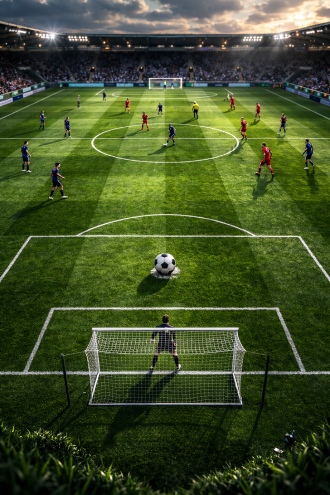
To attain uniformity and safety, the physical environment of soccer is meticulously legislated. The field's dimensions, adherences, and equipment are all brought within the scope of well-defined standards, enabling athletes to smoothly adjust when transitioning from one location to another. Though exact field measurements may stray somewhat within the deviation standards, the overall layout of prominent soccer venues remains identical throughout.
Pitch Dimensions and Markings
A soccer field is rectangular, with touchlines running lengthwise and goal lines at each end. The length and width fall within specified ranges, allowing some flexibility depending on the level of play and available space. Clear markings divide the field into halves and define important areas such as the penalty box, goal area, and center circle.
These markings are not decorative; they determine how rules are applied during play. For example, fouls committed inside the penalty area may result in a penalty kick, while those outside lead to free kicks. Accurate markings are therefore essential for correct decision-making by referees.
The Ball and Its Specifications
The soccer ball must meet specific standards for size, weight, and pressure. It is typically spherical and made of synthetic materials designed to perform consistently in various weather conditions. The ball used in professional matches is tested to ensure predictable movement and durability.
If the ball becomes damaged during play, the referee stops the match and restarts it with a dropped ball. This rule prevents irregular equipment from affecting the outcome of the game. Using a standardized ball helps maintain fairness across different competitions and locations.
Player Equipment and Safety
Players are required to wear a jersey, shorts, socks, shin guards, and appropriate footwear. Shin guards are mandatory and must be covered by socks, as they protect against lower-leg injuries. Jewelry and other potentially dangerous items are not permitted during play.
Goalkeepers wear colors distinct from both teams and the referee to ensure clear identification. Equipment rules are enforced by referees before and during the match. These standards prioritize safety while also helping officials manage the game effectively.
How the Ball Is Played and Goals Are Scored
At the core of soccer is the movement of the ball and the chase of goals. The rules decide the way players may use their bodies and how goals are awarded, three further shaping the real architecture and style of any match. The discipline and iniquity limits the exhibition of advantageous abilities and the hinderance to unfair good steps.
Using the Body and Handling Rules
Outfield players may use any part of their body except their hands and arms to control and move the ball. The goalkeeper is the only player allowed to handle the ball, and only within their own penalty area. Handling offenses occur when a player deliberately touches the ball with their hand or arm.
Referees assess intent, body position, and movement when judging handball situations. Accidental contact may not always be penalized, depending on context. These interpretations aim to balance fairness with the fast-paced nature of the game.
What Counts as a Goal
A goal is scored when the entire ball crosses the goal line between the goalposts and beneath the crossbar, provided no rules have been violated in the process. Goals can be scored from open play, set pieces, or penalties. Each goal counts equally toward the final score.
If the ball does not fully cross the line, no goal is awarded, even if it appears close. This strict definition ensures clarity and prevents disputes. Modern competitions may use goal-line technology to assist referees in making accurate decisions.
Offside and Fair Positioning
The offside rule is often debated because it shapes attacking movement and defensive positioning. A player may be considered offside if, at the moment a teammate passes the ball, they are nearer to the opposing goal than the ball and all but one defender, provided they are not in their own half of the field.
Being in an offside position is not an offense by itself. An offense occurs only if the player becomes involved in active play. This rule discourages goal-hanging and promotes balanced team movement and tactical discipline.
Fouls, Misconduct, and Disciplinary Actions
Football provides precise definitions for fouls and misconduct in order to maintain fairness and safety. These rules manage physical contact and behavior by anticipating what constitutes legitimate challenges and behavior. And referees are responsible for applying these standards uniformly throughout the match.
Common Fouls and Free Kicks
Fouls include actions such as tripping, pushing, holding, or tackling an opponent carelessly or with excessive force. When a foul occurs, the opposing team is awarded a free kick, taken from the spot of the offense or adjusted according to specific rules.
Free kicks may be direct or indirect. A direct free kick allows a goal to be scored directly, while an indirect free kick requires the ball to touch another player first. The distinction depends on the nature of the foul committed.
Yellow and Red Cards
Referees use yellow and red cards to discipline players for misconduct. A yellow card serves as a caution for unsporting behavior, persistent fouling, or dissent. Receiving two yellow cards in the same match results in a red card.
A red card leads to immediate dismissal from the match, and the player’s team must continue with one fewer player. Serious offenses such as violent conduct or denying a clear goal-scoring opportunity often result in a straight red card.
Penalties and Serious Offenses
A penalty kick is awarded when a defending player commits a direct free kick offense inside their own penalty area. The kick is taken from the penalty spot, with only the goalkeeper allowed to defend the goal. This situation places significant pressure on both players involved.
Penalties reflect the seriousness of fouls committed near the goal. They are designed to restore fairness when a clear scoring opportunity is unfairly disrupted. Because of their impact, referees apply strict standards when awarding them.
Officials and Match Control
Soccer matches rely on officials to apply the rules impartially and keep play under control. Their decisions shape the rhythm and fairness of the game. Respect for their authority is a fundamental expectation placed on players and team staff.
The Role of the Referee
The referee is the final authority during a match. They enforce the rules, manage time, stop and restart play, and issue disciplinary actions. Their decisions are based on observation and interpretation of events as they unfold.
Referees are expected to apply advantage when appropriate, allowing play to continue if stopping it would unfairly benefit the offending team. This discretion helps maintain the natural flow of the game while still addressing infractions.
Assistant Referees and Support
Assistant referees operate along the touchlines to help judge offside decisions, throw-ins, and goal kicks. They communicate with the referee using flags and, in professional matches, electronic systems. Their input supports accurate and timely decisions.
In some competitions, additional officials monitor specific areas of the field, such as the goal line. This collaborative approach reduces the likelihood of missed or incorrect calls during critical moments.
Why the Rules Hold the Game Together
Soccer rules do not only regulate play but also provide a basis for fairness, safety, and understanding in any contesting culture. Each rule offers much to the game, regulating everything from match structure and scoring goals to discipline and the effective officiating of the game.
History made 🏆
— FIFA (@FIFAcom) February 2, 2026
The first-ever FIFA Women’s Champions Cup has concluded, crowning @ArsenalWFC as its inaugural winners.
Relive some of the best #FIFAWCC moments 📸 pic.twitter.com/VpRZp8IzLB
With the kind support: